
How the Gut Microbiome Develops Over a Lifetime

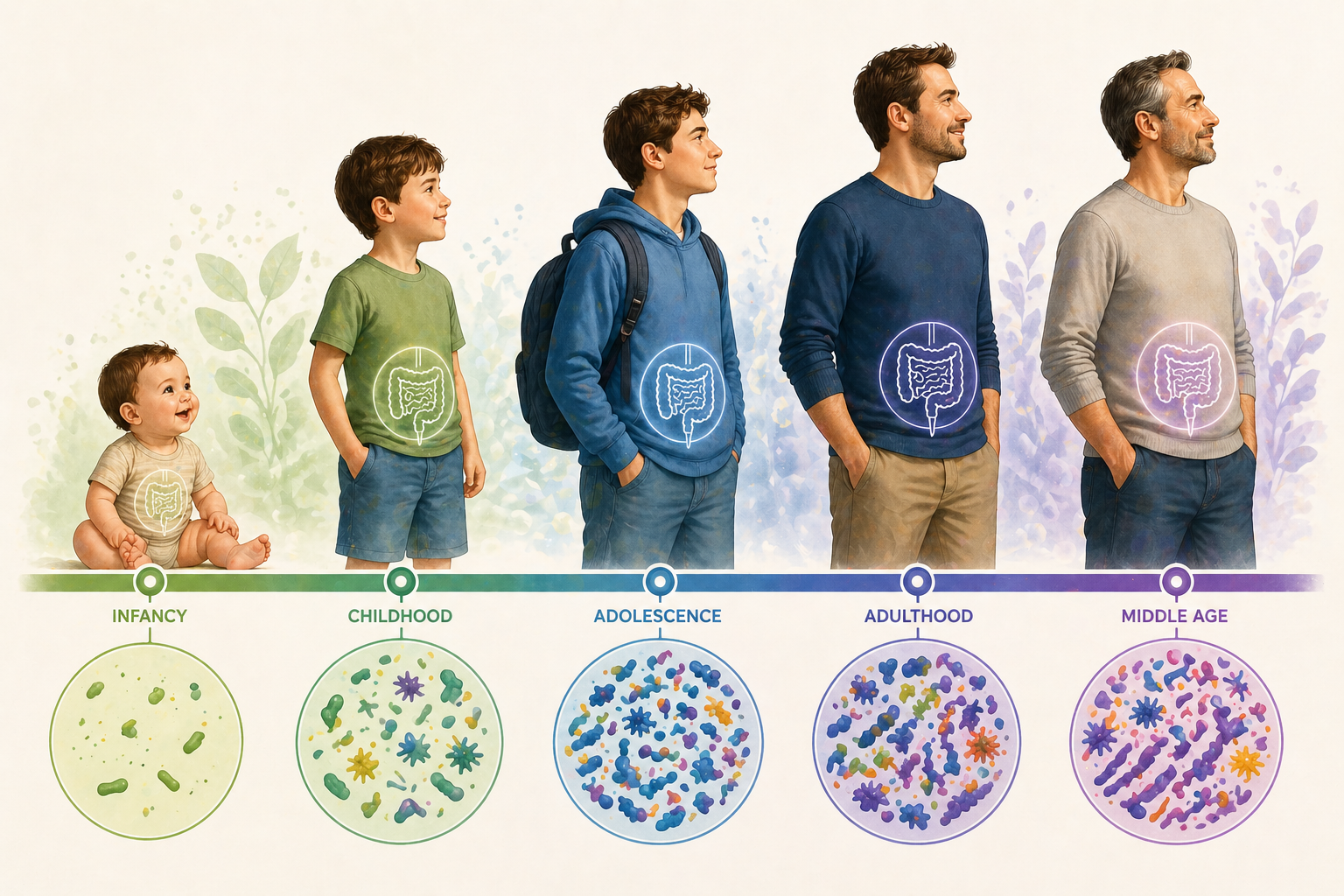
The gut microbiome develops in four distinct phases: a simple, rapidly shifting community in infancy, rapid diversification through childhood, a stable but responsive ecosystem in adulthood, and a more sensitive, lower-diversity landscape in older age. At every stage, diet, medication, sleep, stress, and environment shape how the microbiome develops and functions.
What Is the Gut Microbiome and Why Does It Change Over Time?
The gut microbiome is the collective community of trillions of microorganisms — including bacteria, fungi, viruses, and archaea — living in the digestive tract. It is a dynamic ecosystem that grows, shifts, and adapts continuously in response to the inputs of daily life: what you eat, how you sleep, which medications you take, and the environments you move through.
Unlike eye color or blood type, your microbiome is never static. It reflects your current habits, life stage, and biological environment, which means it can be understood, supported, and improved at any point in life.
How Does the Gut Microbiome Form in Infancy?
The earliest months of life represent the fastest period of microbiome change. The founding microbial community is established through three primary channels: birth mode, early feeding method, and environmental exposure.
Infants born vaginally are colonized by maternal vaginal and gut microbes during delivery. Infants born by cesarean section have a different founding population, more closely resembling skin and environmental microbes. This early difference has measurable effects on immune development that can persist into childhood.
Breast milk provides a second major influence. Human milk oligosaccharides — complex sugars that infants cannot digest themselves — selectively feed beneficial bacterial species, particularly Bifidobacterium, that support immune calibration and gut barrier development. Formula-fed infants develop distinct microbial profiles, though the gap narrows as solid foods are introduced.
Early environmental exposures, such as siblings, pets, outdoor contact, and household microbial diversity, further expand the founding community. Antibiotic exposure during infancy, even a single course, can significantly reduce microbial diversity and alter community composition during a period when the immune system is actively learning to distinguish beneficial organisms from threats.
The infant microbiome is low in diversity and specialized in function: its primary jobs are digesting milk, training the immune system, and establishing the foundational community that will be built on in childhood. The microbiome remains highly adaptable throughout life, but this period sets patterns that influence gut health for years.
How Does the Gut Microbiome Change During Childhood?
Childhood is the period of most rapid microbiome expansion. As children encounter a wider range of foods, environments, and microbial exposures, their gut community diversifies quickly — adding new species, developing new functional capacities, and building the resilience that a more complex diet demands.
The immune system and the microbiome develop in parallel during this period, a process researchers describe as co-training. The immune system learns which microbial species to tolerate and which to suppress, while the microbiome learns to operate within the immune environment its host provides. This bidirectional calibration shapes immune competence and inflammatory thresholds that carry into adulthood.
By ages three to five, the microbiome begins to resemble an adult profile in both diversity and functional capacity. It remains more flexible and responsive than the adult microbiome — more sensitive to dietary shifts, antibiotic exposure, and environmental change — but the core community architecture is taking shape.
Key influences during childhood include dietary variety, outdoor play and soil contact, episodes of illness, antibiotic courses, and the household microbial environment.
What Does the Adult Gut Microbiome Look Like?
Adulthood represents the microbiome's most stable phase. A well-established core community persists across daily variation — maintaining consistent functional output in digestion, metabolism, and immune regulation — while day-to-day composition shifts in response to meals, sleep, stress, travel, and physical activity.
A healthy adult microbiome is characterized by high diversity, a balanced mix of species covering the full range of functional roles, and resilience — the capacity to recover from disruption and return to baseline. Microbial diversity is a primary marker of that resilience: a wider range of species gives the ecosystem more capacity to absorb perturbation without losing functional stability.
The factors that most significantly alter the adult microbiome are changes in dietary patterns, antibiotic and medication use, sustained stress and sleep disruption, alcohol consumption, physical activity level, and environmental shifts. Most of these perturbations produce temporary fluctuations that a resilient microbiome recovers from. Repeated or sustained disruptions — particularly repeated antibiotic courses or chronically poor diet — produce longer-lasting compositional shifts.
This daily variability in an otherwise stable system is why multi-sample collection matters for accurate microbiome assessment. A single sample captures a moment in an ecosystem that is continuously fluctuating. Three samples collected across a week reveal the patterns that persist regardless of daily noise.
How Does the Gut Microbiome Change in Older Adulthood?
As the body ages, the gut microbiome undergoes a gradual but consistent shift. Microbial diversity tends to decline. Populations of beneficial species — particularly butyrate-producing bacteria that nourish the gut lining and suppress inflammation — often decrease. The ecosystem becomes more sensitive to dietary changes, medication use, and illness.
Several interconnected factors drive these changes. Digestion slows, altering the gut environment that microbes inhabit. Dietary variety often narrows, reducing the fiber diversity that sustains a wide range of microbial species. Medication use increases, with documented effects on microbial composition by proton pump inhibitors, antibiotics, and other commonly prescribed drugs. Physical activity decreases. The immune system itself ages — a process called immunosenescence — changing the regulatory environment that shapes which microbes are permitted to thrive.
These changes are a normal feature of biological aging. But they underscore why nutrition, consistent physical activity, and gut-supportive habits become increasingly important as protective factors in later life. The microbiome remains responsive to intervention at every age. It is never too late to support it.
What Factors Shape the Gut Microbiome Across Every Life Stage?
Regardless of age, five categories of input consistently have the greatest influence on gut microbiome composition and function:
Diet — particularly fiber diversity and fermented food intake — is the single most modifiable driver of microbiome composition. Different fiber types selectively feed different microbial populations. A diet that rotates fiber sources across plant types supports a wider, more resilient microbial community than one that relies on a narrow range of foods.
Medications — antibiotics, most notably, but also proton pump inhibitors, metformin, and certain antidepressants — have documented, measurable effects on microbial composition that extend beyond the treatment period.
Sleep and stress influence the gut microbiome through the gut-brain axis, a bidirectional communication network between the digestive tract and the brain that operates via neural, hormonal, and immune pathways. Chronic sleep disruption and sustained psychological stress alter gut motility, immune signaling, and microbial balance in ways that compound over time.
Physical activity is consistently associated with greater microbial diversity and higher abundance of butyrate-producing species in physically active individuals compared to sedentary ones.
Environmental exposure — to soil, animals, outdoor environments, and diverse human contact — introduces microbial variety that supports community resilience, particularly during developmental windows in infancy and childhood.
Frequently Asked Questions
How does the gut microbiome develop from birth? The gut microbiome is established by birth mode, early feeding practices, and environmental exposures in the first months of life. Vaginally born and breastfed infants develop distinct founding communities compared to cesarean-born or formula-fed infants. These early differences influence immune development and microbial composition into childhood.
At what age is the gut microbiome fully developed? The gut microbiome reaches an adult-like profile in terms of diversity and functional capacity by approximately ages three to five. It continues to shift throughout adulthood in response to diet, medication, stress, and environment — and undergoes further compositional changes in older age as diversity tends to decline.
Why does microbial diversity decrease with age? Age-related declines in microbial diversity are driven by multiple converging factors: slowing digestion, narrowing dietary variety, increased medication use, reduced physical activity, and immunosenescence — the gradual aging of the immune system that changes the regulatory environment microbes inhabit.
What is butyrate and why does it matter for aging? Butyrate is a short-chain fatty acid produced when gut bacteria ferment dietary fiber. It is the primary energy source for colonocytes — the cells lining the colon — and plays a direct role in reducing intestinal inflammation and maintaining gut barrier integrity. Declining butyrate-producing bacterial populations in older adulthood are associated with increased gut permeability and systemic inflammatory activity.
Can the gut microbiome improve later in life? Yes. The microbiome remains responsive to dietary and lifestyle intervention at every age. Increasing fiber diversity, consistent physical activity, adequate sleep, and reduced unnecessary antibiotic use all support microbiome resilience in older adults. The rate of change may be slower than in younger life stages, but the capacity for improvement does not disappear with age.
Why does antibiotic use affect the gut microbiome so significantly? Antibiotics eliminate bacterial populations indiscriminately — targeting pathogens but also disrupting beneficial species that took years to establish. Recovery of the pre-antibiotic community can take months, and some species may not return to prior abundance levels. Repeated antibiotic courses compound this disruption, making each subsequent recovery less complete than the last.