
Gut Microbiome Test vs GI Test: What Each One Actually Tells You

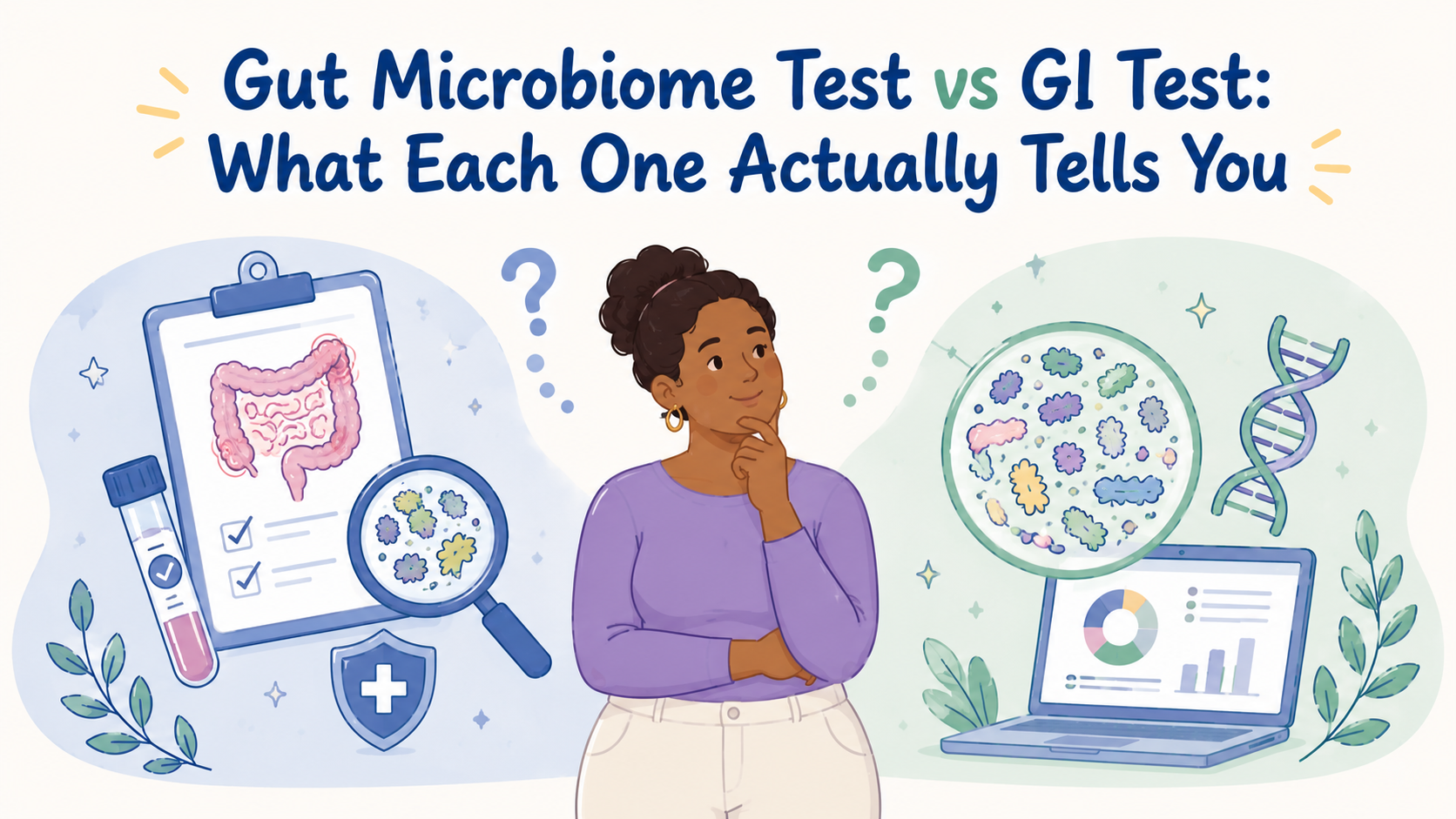
A gut microbiome test and a GI diagnostic test answer two different questions. Traditional GI tests look for a specific problem a provider already suspects, such as infection, bleeding, or inflammation. Gut microbiome sequencing describes the wider community of microbes living in your digestive tract and how they function. One finds disease. The other maps your biology.
There is a moment that happens in a lot of doctors' offices. Someone slides a stool collection kit across the desk, and the patient hears the word "test" and assumes it means the same thing as the microbiome kit they saw advertised on Instagram. The two get filed in the same mental folder. They should not be.
Both involve a sample. Both come back with a report. From there, the resemblance mostly ends. A traditional gastrointestinal test is a targeted instrument built to answer a narrow clinical question. Gut microbiome sequencing is a wide-angle lens on an ecosystem. Understanding where the line falls between them is the difference between using each tool well and expecting one to do a job it was never designed for.
This piece walks through both. What each one measures, why a provider would order it, what it is genuinely good at, and where its limits are. The goal is not to crown a winner. These tools sit in different parts of your health picture, and the honest version of the story is more useful than the marketing version.
Why do people confuse GI tests with microbiome testing?
Both categories examine what comes out of your gut, so the confusion is understandable. The deeper reason is that the word "test" carries an implied promise of a verdict: pass or fail, sick or well, positive or negative. Traditional GI diagnostics are built to deliver exactly that kind of verdict for a specific condition. Microbiome sequencing offers something different in nature. It produces a detailed description rather than a diagnosis, and a description invites interpretation instead of settling a question.
Marketing has blurred the edges further. Plenty of companies present a microbiome report in the visual language of a clinical lab result, with red flags and numbers and health scores. That styling nudges people to read the report the way they would read the bloodwork from a doctor's visit, where a value sits against a normal range and signals clearly whether something is in or out of bounds. A 2025 international consensus published in The Lancet Gastroenterology & Hepatology addressed this head-on, cautioning that many commercial reports imply more clinical certainty than the underlying science currently supports (Porcari et al., 2025).s people to read it.
Why does your gut microbiome matter for your overall health?
Your gut is home to trillions of microbes that do real work every day. They help break down food, produce vitamins and other compounds your body relies on, help train and regulate your immune system, shape how you process energy, and stay in constant chemical conversation with your brain. Scientists increasingly treat this community as something close to an organ in its own right, and the recognition that its role in human health is real and important keeps growing (Porcari et al., 2025).
Here is the part worth getting excited about. Much of your biology is fixed, but your microbiome shifts with what you eat, how you sleep, the medications you take, and how you move. That makes it one of the most responsive levers you have over your long-term health, and a system you can actually shape once you can see it. Everything starts with a baseline.
What is a traditional GI test?
A traditional GI test is a targeted diagnostic tool a healthcare provider orders to detect or rule out a specific gastrointestinal condition. Each one is designed around a defined clinical question, and each has decades of validation behind it. Here is what the common ones do.
Stool-based diagnostics
Stool culture and GI pathogen PCR panels hunt for infection. A culture grows suspected bacteria from a sample so a lab can identify them. Modern multiplex PCR panels scan the same sample for the genetic signatures of dozens of bacteria, viruses, and parasites at once. Providers reach for these when someone has acute or persistent diarrhea and the cause needs a name. The strength is precision: the panel is looking for a known list of troublemakers. The limit is the same thing in reverse. It reports on the presence of a limited number of very specific pathogens it is built to detect, but that’s it.
Ova and parasite (O&P) testing examines stool under a microscope for parasites and their eggs, typically after travel, prolonged diarrhea, or exposure risk. It is inexpensive and direct, though it can require several samples because parasites shed intermittently.
Fecal occult blood testing (FOBT) and the fecal immunochemical test (FIT) detect hidden blood in stool. FIT is the more specific of the two because it reacts to human hemoglobin rather than to diet. Both serve as first-line, at-home screening for colorectal cancer. The US Preventive Services Task Force recommends colorectal cancer screening for average-risk adults beginning at age 45, and FIT is one of the endorsed methods (US Preventive Services Task Force, 2021). A FIT result flags whether a colonoscopy is warranted. It does not, on its own, confirm cancer.
Fecal calprotectin measures a protein released by white blood cells in the intestinal lining, which makes it a marker of inflammation in the gut. Providers use it to help determine diagnosis of a gastrointestinal disease and need for colonoscopy and further testing. While FCal is commonly used for diagnosis and monitoring of inflammatory bowel disease (IBD), it can also suggest severe gastrointestinal infections, colorectal cancer or polyps, diverticulitis, damage caused by celiac disease, or even gut damage from use of medications like NSAIDs. It is a sensitive signal of inflammation, though it points to the presence of inflammation without naming its cause.
Fecal elastase gauges how well the pancreas is producing digestive enzymes. A low result suggests exocrine pancreatic insufficiency, a condition where food is not being broken down properly. It is a focused window into one organ's function.
C. difficile testing looks for the C. difficile bacterium or its toxins, usually in someone with diarrhea after antibiotics or a hospital stay. H. pylori stool antigen testing detects proteins from Helicobacter pylori, the bacterium linked to ulcers and certain stomach conditions, and is used both to diagnose an active infection and to confirm that treatment worked.
Procedures and breath tests
Colonoscopy and upper endoscopy are the visual tools. A camera on a flexible tube lets a gastroenterologist or trained health provider look directly at the lining of the colon or upper digestive tract, take biopsies, and remove polyps in the same session. Colonoscopy remains the reference standard for colorectal cancer screening precisely because it does two jobs at once: it finds abnormal tissue and it removes it. The trade-offs are real. These procedures are invasive, require preparation and often sedation, and carry a small risk of complications, so they are reserved for situations that justify them clinically.
Intestinal ultrasound is reshaping part of that picture. It is a noninvasive, radiation-free imaging tool a provider can use at the bedside to see the thickness and layers of the bowel wall, and it is being adopted more widely to evaluate and monitor conditions such as inflammatory bowel disease with no preparation or sedation required. Research places its accuracy for assessing disease activity on par with endoscopy and MR imaging, and it has only recently entered routine use in the United States after years of established practice in Europe (Krugliak Cleveland et al., 2023). Its reach has limits. Ultrasound reads inflammation and structure, and it cannot take a tissue sample or separate one cause of inflammation from another, so scope keeps its central role for definitive diagnosis and biopsy. For many patients, the two work in sequence: ultrasound for frequent, comfortable monitoring, and colonoscopy when tissue or a firm diagnosis is needed.
Breath tests capture gases you exhale after drinking a sugar solution. A hydrogen and methane breath test screens for small intestinal bacterial overgrowth (SIBO); a lactose breath test checks for lactose intolerance. They are noninvasive and useful for the specific conditions they target, and their interpretation continues to be refined by clinical research.
GI-related blood work rounds out the picture. Markers such as C-reactive protein signal inflammation somewhere in the body, and results are read alongside stool findings. A lot of clinical blood work helps providers find and diagnose existing issues or tells them which test to run next.
The through-line across every one of these tools is intent. A provider orders them because there is a symptom, a risk factor, or a condition to investigate. They are questions with a suspected answer already in mind.
What is the Dayhoff Health ‘Gut Microbiome Program’?
The Dayhoff Health Gut Microbiome Program is a sequencing-based service that reads the full genetic content of your gut sample to describe which microbes live there and what they are equipped to do. It runs through a CLIA-certified laboratory. Rather than checking for a short list of known pathogens, it uses shotgun metagenomic sequencing, a method that reads the complete DNA in a sample instead of scanning for a handful of predefined names.
That depth changes what becomes visible. The program characterizes the composition of your gut community, its diversity, the relative abundance of different organisms, and the functional pathways those microbes carry, meaning the biological jobs they are capable of performing. Around two-thirds of the species living in the human gut were unknown to science until recently, and a method that reads everything present has a chance of surfacing groups that narrower panels do not identify.
The program is built around a triple-sample design. Reproducibility has been a persistent weakness across consumer microbiome testing, a point documented when researchers at the National Institute of Standards and Technology and the University of Maryland sent identical stool material to seven companies and found major discrepancies in the results (Servetas et al., 2026). Sequencing more than one sample is a direct response to that analytical-validity problem, aimed at producing a stable reading rather than a single snapshot.
A word on how the program reports results, because the philosophy matters. The gut is a highly redundant system. Many different microbes perform the same functional role, so the absence of one well-known organism often means very little when a dozen others cover the same job. Dayhoff Health reports on functional capacity across the community instead of raising alarms about individual missing species, which keeps the focus on what your gut can actually do rather than on scaring people toward supplements and products they may not need.
One boundary deserves to be stated plainly. The Gut Microbiome Program is a wellness and health-intelligence tool. It is not a diagnostic device, and there is currently no FDA-cleared gut microbiome test for diagnosing disease in the United States (Servetas et al., 2026; Porcari et al., 2025). Anyone with symptoms that need a medical answer should work with a provider and the diagnostic tools built for that purpose. But results from our tool helps uncover weaknesses in the system and identify problems both before anything is wrong and even after an illness has arisen, which can help suggest what doctor-prescribed clinical tests to start with to find a clinical solution.
Looking for disease versus understanding your biology
Here is the cleanest way to hold the distinction. Traditional GI testing is diagnostic. It exists to catch something that has likely already gone wrong, and it does that job with validated precision. Microbiome sequencing is descriptive and, at its best, preventive-minded. It offers a baseline picture of your biology while you feel well, so you have a reference point and a place to notice change over time.
A stool PCR panel answers, "Is a known pathogen causing this person's diarrhea?" A colonoscopy answers, "Is there abnormal tissue in this colon?" A microbiome program answers a broader and softer question: "What is the state of this person's gut ecosystem right now, and what might that suggest about wellness, diet and daily habits?" These are genuinely separate inquiries. Expecting the sequencing report to diagnose an infection, or expecting the pathogen panel to describe your whole microbial community, asks each tool to be something it is not.
When would a provider order traditional GI testing?
A provider orders GI diagnostics when there is a clinical reason to investigate. Persistent diarrhea, blood in the stool, unexplained weight loss, severe abdominal pain, or a family history of colorectal cancer all point toward specific tests. Someone returning from travel with GI symptoms may get O&P and a pathogen panel. Someone with suspected IBD may get fecal calprotectin followed by colonoscopy. Someone turning 45 gets a colorectal cancer screening conversation regardless of symptoms, because screening at that age carries a favorable balance of benefit and risk for the average-risk adult (US Preventive Services Task Force, 2021).
The common thread is that these are medical decisions, made by a provider, in response to symptoms or established risk. That is the appropriate home for diagnostic testing, and it is where the strongest evidence lives.
When might microbiome profiling add context?
Microbiome sequencing tends to be most useful for anyone who wants a fuller understanding of their own biology. It suits people establishing a baseline before making a diet or lifestyle change, people tracking how their gut shifts over months, and people who want their conversations with a clinician or dietitian to start from specifics instead of generalities.
It also fills a documented blind spot. A standard annual physical measures broad immune cells, proteins, and hormones that are used to flag illnesses, and similar markers that flag disease once something is already off. None of them describes the gut microbiome. Sequencing addresses that gap by identifying which microbes are present and what they are equipped to do, information a routine annual physical does not capture.
The honest framing is context, not conclusion. A microbiome report gives you and your provider more to work with. It does not, by itself, deliver a medical verdict.
How do the two approaches compare?
Neither column replaces the other. They answer different clinical and personal questions, and read together they cover more ground than either does alone.
Can the two approaches complement each other?
They can, and the most sensible use of microbiome data treats it as a complement to good clinical care rather than a substitute for it. An annual physical and standard bloodwork are genuinely powerful tools for catching problems early. A colonoscopy saves lives. None of that changes because a person also has a picture of their microbiome.
Where sequencing adds value is in the conversation. Bring a functional summary of your gut to a provider or dietitian, and the discussion about nutrition and daily habits gets more specific. The microbiome data supplies context; the clinician supplies judgment and, when needed, the diagnostic tests that deliver medical answers. The consensus panel made the division of labor explicit: interpretation that carries therapeutic weight belongs with the healthcare provider who knows the whole patient, not with the testing laboratory (Porcari et al., 2025).
What does current research say about microbiome-guided nutrition?
The research is genuinely promising and genuinely early, and both halves of that sentence are true at once. A growing body of evidence connects the gut microbiome to digestion, immune signaling, and metabolism, and interest in using microbiome data to personalize nutrition is intense.
The caution is that turning population-level associations into reliable individual advice is hard. Many microbiome–disease associations weaken once researchers rigorously adjust for confounding factors, and the field still lacks the large, controlled trials measuring large, controlled trials that track concrete health outcomes over time that would move microbiome-guided nutrition from promising to proven (Porcari et al., 2025). Knowing that someone carries less of a given bacterium is only actionable once science can say which dietary or lifestyle changes reliably shifts it and what measurable benefit follows. That work is underway. It is not finished. The responsible position is to treat microbiome-informed nutrition as a useful and evolving input rather than a settled prescription.
Where is microbiome science headed over the next decade?
The trajectory points toward standardization and depth. The reproducibility gaps that surfaced across consumer testing have prompted the development of standardized reference materials, which should make results more comparable across laboratories over time (Servetas et al., 2026). Sequencing continues to grow deeper and cheaper, reference databases keep expanding, and machine learning is starting to find patterns in microbiome data that individual researchers would miss.
Two forces will shape the decade. The first is analytical rigor: better standards, better quality control, and reporting that states its own limits honestly. The second is functional understanding, the shift from cataloging which microbes are present to understanding what they do and how reliably a given intervention changes it. As those two mature together, microbiome data will earn a larger and better-defined role in preventive health. The near-term reality is that the science is advancing quickly.
Frequently Asked Questions
Is a gut microbiome test the same as a GI test? No. A GI test is a targeted diagnostic tool that looks for a specific condition such as infection, bleeding, or inflammation. A gut microbiome test describes the wider community of microbes in your gut and how they function. They answer different questions.
Can a gut microbiome test diagnose disease? Not directly. There is currently no FDA-cleared gut microbiome test for diagnosing disease in the United States. Microbiome sequencing is a wellness and health-intelligence tool. Diagnosis requires clinical evaluation and validated diagnostic tests ordered by a provider.
When should I ask my provider about a GI test? Talk with a provider if you have persistent diarrhea, blood in your stool, unexplained weight loss, severe abdominal pain, or a family history of colorectal cancer. Colorectal cancer screening is recommended for average-risk adults starting at age 45, and earlier for those with known family history of GI diseases.
Why do consumer microbiome test results sometimes differ between companies? Because methods differ. When researchers sent identical stool material to seven companies, results varied significantly across providers, largely due to differences in collection, processing, and analysis. Sequencing multiple samples and running them through a certified laboratory helps produce a more stable reading. The Dayhoff Health Gut Microbiome Program is built to give you and your provider a clear read of your gut health, with no supplement to sell you, and no quick fix attached. Where your results lead is a conversation between you and the provider you trust.
Is the Dayhoff Health program lab-certified? Yes. The Dayhoff Health Gut Microbiome Program runs through a CLIA-certified laboratory and uses shotgun metagenomic sequencing across a triple-sample design.
Should I use one or the other? Often both, for different reasons. Diagnostic GI testing answers medical questions when symptoms or risk are present. Microbiome sequencing gives you a baseline picture of your biology and a reference point over time. Read together with a provider, they cover more than either does alone.
References
- Porcari S, Mullish BH, Asnicar F, Ng SC, Zhao L, et al. International consensus statement on microbiome testing in clinical practice. The Lancet Gastroenterology & Hepatology. 2025;10(2):154–167.
- Servetas SL, Jackson SA, et al. Evaluating the analytical performance of direct-to-consumer gut microbiome testing services. Communications Biology. 2026;9:269. doi:10.1038/s42003-025-09301-3.
- US Preventive Services Task Force. Screening for Colorectal Cancer: US Preventive Services Task Force Recommendation Statement. JAMA. 2021;325(19):1965–1977.
- University of Cambridge-led global gut microbiome study across 39 countries (CAG-170 finding). [Source and citation to confirm before publication.]