
Clinical Insight vs. Wellness Trends: What Health Systems Should Know About Gut Microbiome Testing

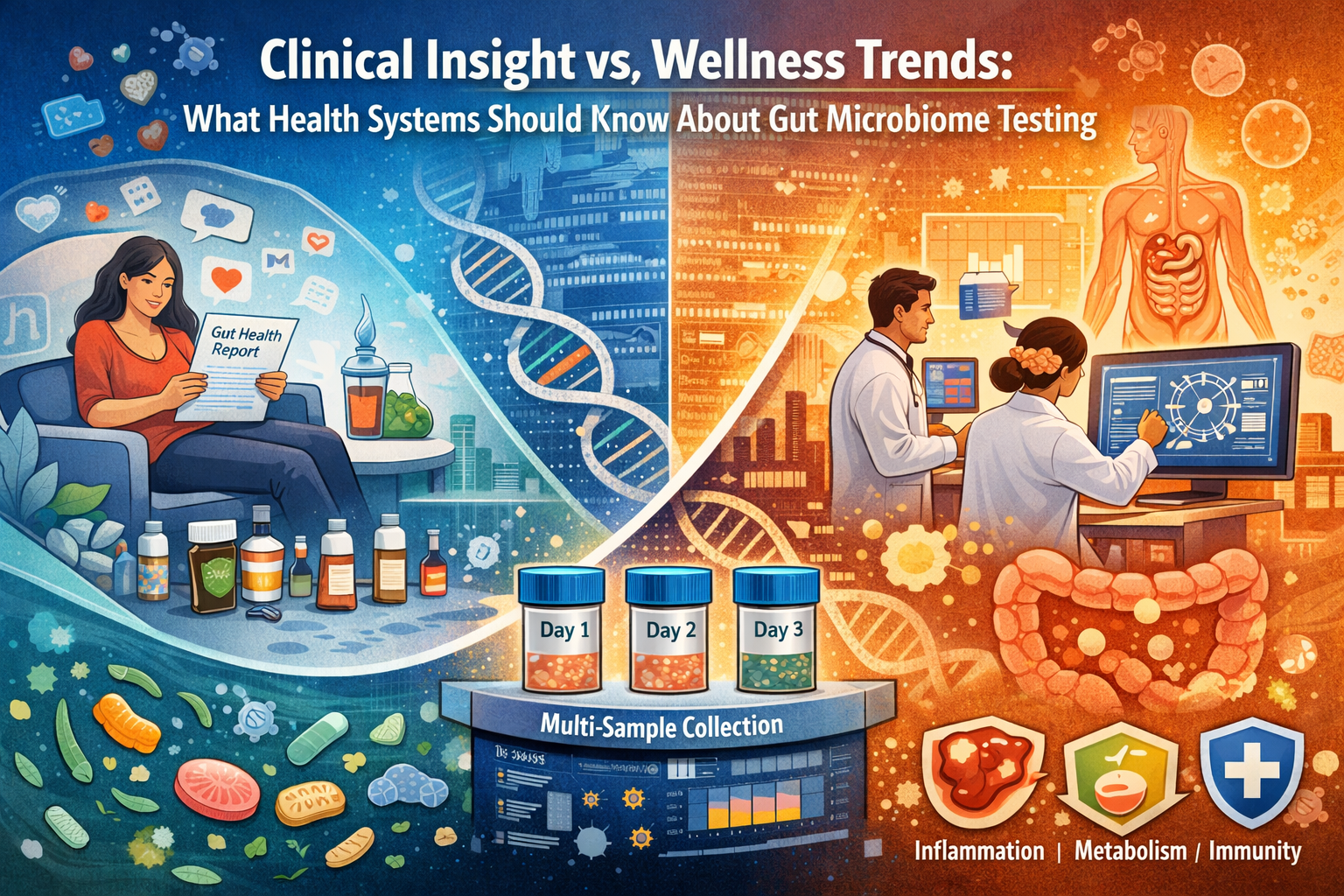
Most consumer gut microbiome tests were built for engagement, not clinical reliability. For employers and health systems, the distinction matters: clinically aligned microbiome testing uses multi-sample collection and high-resolution sequencing to surface early biological signals — in inflammation, metabolic function, and immune activity — that traditional screenings consistently miss.
What Separates Clinical Microbiome Testing from Wellness Trends?
Gut health has become a mainstream consumer category, but for employers and health systems, the relevant question is not what is trending — it is what is clinically meaningful. Most consumer microbiome tests were designed for engagement. They rely on a single sample, shallow sequencing, and reports that seem informative but rarely yield stable, actionable findings.
For organizations, that gap creates two concrete problems. Employees receive data that is not sufficiently stable to guide behavior or clinical conversations. Benefits teams absorb the downstream confusion as employees bring inconsistent, poorly contextualized results to HR, wellness coaches, and primary care providers asking what to do with them.
Clinically aligned microbiome testing is built to a different standard — one that produces findings stable enough to inform preventive health decisions at both the individual and population level.
Why Does Gut Microbiome Testing Belong in Employee Health Programs?
The gut microbiome — the collective community of trillions of bacteria, fungi, viruses, and archaea living in the digestive tract — interfaces directly with inflammation, metabolic function, immune regulation, and the gut-brain axis. Because it responds to diet, sleep, stress, and medication simultaneously, it reflects biological change earlier than most systems that standard screenings measure.
For employers focused on cost control and early detection, that early visibility has direct organizational value. Microbiome testing offers insight into inflammatory and metabolic patterns that often precede chronic conditions; a window into digestive and immune function that influences absenteeism and presenteeism; a personalized, biology-first experience that increases engagement with preventive care; and a non-invasive, low-burden collection process that integrates easily into annual or onboarding health programs.
Dysbiosis — a disruption in the balance and function of the gut microbial community — is associated with conditions that drive significant plan spend, including metabolic syndrome, inflammatory bowel conditions, and immune dysregulation. Identifying those patterns early creates an intervention opportunity that claims data, arriving 12 to 18 months after the fact, cannot provide.
What Makes Microbiome Testing Reliable Enough for Organizational Use?
To be useful at the organizational level, microbiome testing must meet a higher bar than consumer wellness products. Employers need data that is stable across days rather than dependent on a single meal or stressful morning, high-resolution enough to identify organisms at the species and strain level, interpretable with insights tied to published research rather than generic lifestyle guidance, and consistent across populations to enable trend analysis and program evaluation.
This is where methodology becomes the deciding factor. A single-sample test cannot distinguish a stable biological pattern from a transient daily fluctuation. Shallow sequencing — such as 16S rRNA methods used by most consumer tests — identifies bacteria only at the genus level, misses fungi and viruses entirely, and provides no insight into microbial function. Neither is sufficient for clinical interpretation at the individual or population level.
How Does Multi-Sample, High-Resolution Testing Serve Organizational Goals?
Shotgun metagenomic sequencing reads all the genetic material in a sample — not a single marker gene — identifying organisms at the species and strain levels and revealing the functional pathways those organisms contribute to. Paired with multi-day sample collection, it produces a biological baseline that reflects actual gut function rather than a single day's conditions.
For organizations, this methodology supports more accurate identification of early biological patterns correlating with inflammation, metabolic strain, or gut-immune imbalance. It produces individual reports precise enough to reduce employee confusion and downstream follow-up burden. It increases engagement because employees receive personalized, credible insights rather than generic ones. And it enables population-level analytics that allow employers to understand workforce health trends without being misled by daily noise in individual results.
When employees receive stable, clinically grounded findings, they are more likely to act on them — and less likely to generate downstream clarification burden for HR and benefits teams.
Why Are Organizations Moving Beyond Traditional Screenings?
Standard health screenings capture important metrics, but they are designed to detect change only after it has become clinically significant. The microbiome offers a different kind of signal — patterns that shift early, often months or years before traditional markers cross diagnostic thresholds.
For organizations, that earlier signal means more opportunities for intervention before conditions progress to high-cost utilization, better alignment with preventive care goals rather than reactive disease management, reduced long-term risk and plan spend as early patterns are identified and addressed, and a more complete picture of workforce population health than biometric screening alone provides.
Microbiome testing is not a replacement for existing screening programs. It is an additional data layer — one that captures what standard screenings, by design, are not built to see.
What Should Health Systems Look for When Evaluating Microbiome Testing Partners?
Not all microbiome testing is equivalent, and the differences matter at the organizational scale. The methodological questions worth asking before selecting a testing approach: Does the test collect multiple samples across multiple days, or rely on a single collection point? Does sequencing identify organisms at the species and strain level, or only at the genus level? Do reports surface functional pathway data — what microbes are doing — or only compositional data about what is present? Are findings tied to peer-reviewed research, or to proprietary wellness frameworks? Is individual data privacy protected and never shared with the employer?
Clinically aligned microbiome testing answers all five questions in a way that consumer wellness products do not.
Frequently Asked Questions
What is the gut microbiome? The gut microbiome is the community of trillions of microorganisms — including bacteria, fungi, viruses, and archaea — living in the digestive tract. It plays a direct role in digestion, immune regulation, metabolic function, inflammation, and gut-brain signaling.
What is dysbiosis? Dysbiosis is a disruption in the balance, diversity, and functional capacity of the gut microbial community. It is associated with increased inflammatory activity, metabolic strain, immune dysregulation, and reduced gut barrier integrity — and can be detected through microbiome testing before clinical symptoms appear.
Why is a single gut microbiome sample insufficient for organizational use? A single sample captures one moment in a dynamic system that shifts daily in response to diet, sleep, stress, and medication. Without multi-day collection, there is no way to distinguish a stable biological pattern from a transient daily fluctuation — making individual findings unreliable and population-level trend analysis invalid.
What is shotgun metagenomic sequencing? Shotgun metagenomic sequencing reads all the genetic material present in a sample rather than a single marker gene. It identifies organisms at the species and strain levels — including bacteria, fungi, viruses, and archaea — and reveals the functional pathways they contribute to in digestion, metabolism, and immune regulation.
How does microbiome testing complement existing employee health programs? Microbiome testing adds an early-signal layer that standard screenings are not designed to provide. Traditional biometric and lab screenings detect change once it has crossed clinical thresholds. Microbiome testing detects directional patterns earlier in the process — giving employers an opportunity to intervene before conditions progress to high-cost utilization.
Is individual employee microbiome data shared with employers? No. Individual results remain private to the employee. Employers receive de-identified population-level analytics that reflect workforce trends without exposing any individual's personal health data.