
The 2027 Health Benefits Numbers, in One Place

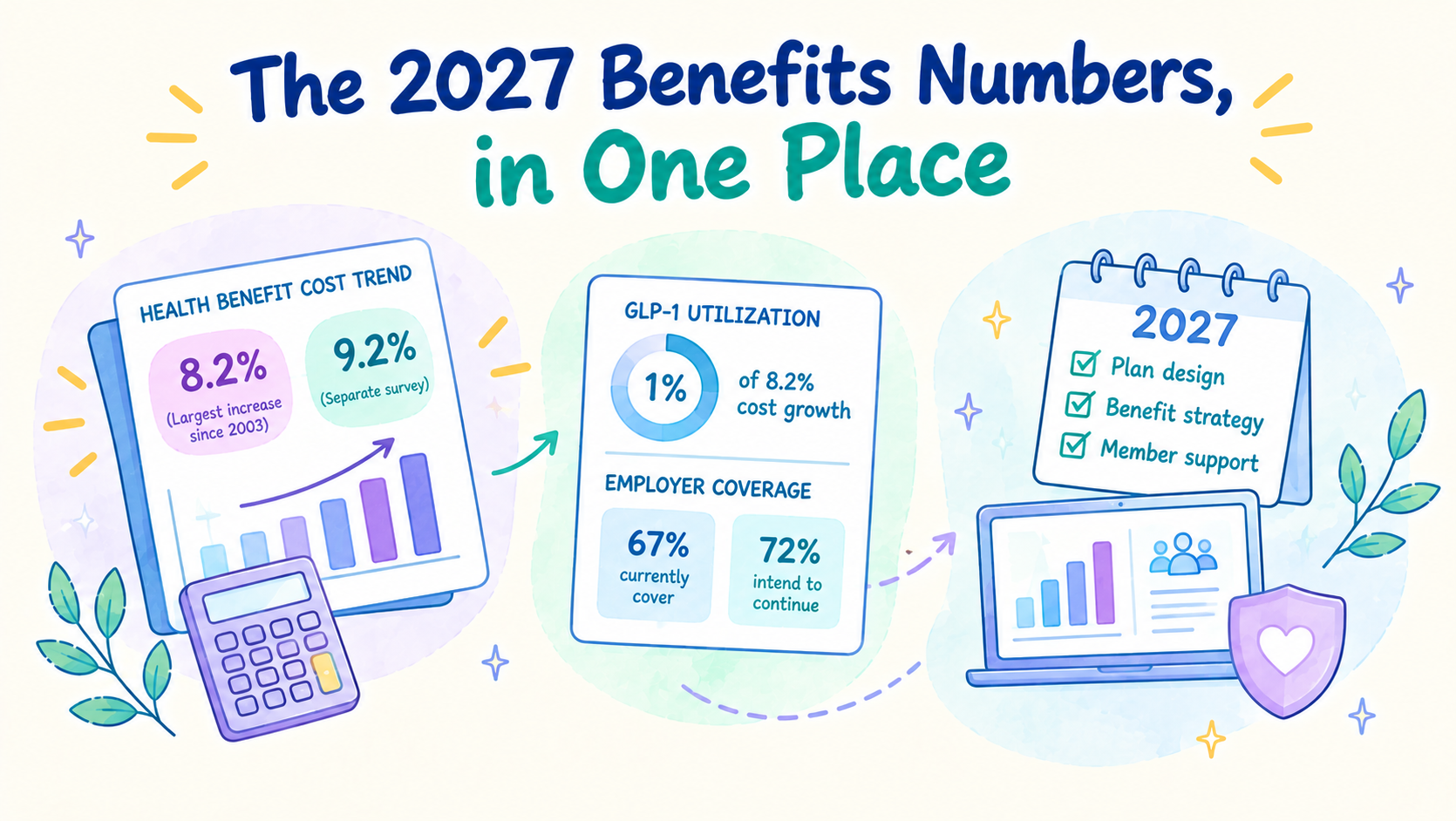
Two employer surveys project 2027 health benefit costs rising 8.2 and 9.2 percent. The 8.2 percent figure is described as the largest increase since 2003. Rising GLP-1 utilization accounts for about one percentage point of it. Most large employers covering these drugs intend to continue.
If you are finalising plan design for 2027, every number you need is now public. Nothing further is coming before open enrollment. This is a summary of what the surveys say, what one state's experience adds, and what is still unknown, assembled so that it can be read in one sitting and taken into a meeting.
What do the 2027 benefits cost projections actually say?
Two surveys carry most of the weight, and they are separate instruments with separate samples, so they should be read side by side rather than averaged.
In early September, a preliminary survey of more than 1,800 employers projected average health benefit costs rising 8.2 percent in 2027. The firm conducting it described that as the largest increase since 2003. Separately, in late August, a survey organization representing large employers projected a 9.2 percent cost trend, and in a further September release reported on GLP-1 coverage specifically among 105 large employers.
The two figures are not in conflict. They are different populations answering at different moments, and the gap between them is smaller than the gap between either one and the increases employers have been planning around for the past decade.
How much of that is GLP-1 utilization?
The 8.2 percent survey attributes a full percentage point of 2027 cost growth to rising GLP-1 utilization. That is the single most useful number in the set, because it is the one that converts a general cost problem into a specific line item a benefits committee can discuss.
The coverage picture underneath it is more stable than the headlines suggest. Among the 105 large employers surveyed in September, 67 percent currently cover GLP-1s for weight management, and of those, 72 percent intend to continue covering them in 2027. That is a clear majority holding. It also means roughly one in ten of the employers currently covering are not planning to.
The chief actuary on the larger survey put the mechanism plainly: some employers needing immediate cost relief chose to drop GLP-1 coverage for next year. Not a strategic repositioning. A relief valve.
What happens after a coverage change lands?
Until September, this was a question employers had to answer by estimate. Then a state body published the first hard measure.
A report presented to the Massachusetts Health Policy Commission in mid-September found that between late 2025 and early 2026, 112,000 fewer commercially insured residents used GLP-1s for weight loss, a decline of roughly half, after most private insurers in the state ended automatic coverage in January. Annualised 2026 commercial spending on these medications is projected at 662 million dollars, against nearly one billion in net spending the prior year. At the state's two largest insurers, coverage for obesity-related GLP-1 use fell from 6 percent to 3.7 percent of members, and from 6.5 percent to 3.3 percent.
Two things are worth drawing out of that, and they point in opposite directions.
The spending reduction is real and large. So is the utilization reduction, and the second one is the part that does not appear on a cost line. Roughly half the people in that state who had been using these medications for weight management stopped. Some of them will have chosen to. Many will not have. A benefits decision that works on the spreadsheet also lands in a population, and the Massachusetts figures are currently the only published look at how hard.
One caution on using these numbers. The Commission's own release was not reachable at the time of writing; the figures above are as reported consistently by two Massachusetts news organisations whose accounts agree. They describe one state, one year, and one set of insurer decisions. They are a data point about what a coverage change does, not a forecast for any other plan.
Where does wellness monitoring fit?
Carefully, and not where a vendor would usually put it.
Monitoring does not reduce a cost trend, and nothing in this piece should be read as a claim that it does. It is not a coverage strategy and it is not a substitute for one. Whether a plan covers these medications in 2027 is a decision about benefit design, and it belongs to the people making it.
What monitoring is, is a layer that stays useful whichever way that decision goes. A population that is being measured produces risk visibility: aggregate, de-identified signal about where modifiable risk markers sit and how they concentrate, available on a timescale that claims data does not offer. Claims arrive 12 to 18 months after the fact. Biometric screening produces a one-time snapshot with no population synthesis. Neither answers the question a benefits team is actually asking in October, which is where to put next year's money.
Dayhoff Health runs an employer-sponsored at-home program built around that distinction. Individual results go directly to the employee, in plain language, designed to be taken to their own provider. The employer receives aggregate population reporting and nothing else. No individual data is shared with the employer. Ever, and the boundary is written into the data use agreement rather than described in a policy document.
The numbers in this piece are the ones everyone has. The question of what a workforce actually looks like underneath them is still open, and it is answerable.
Frequently Asked Questions
Are the 8.2 and 9.2 percent projections measuring the same thing?
No. They come from two separate surveys with different samples and different field dates, and should be read side by side.
How many employers are dropping GLP-1 coverage?
Among 105 large employers surveyed in September, 67 percent cover GLP-1s for weight management and 72 percent of those intend to continue in 2027.
Does the Massachusetts data predict what will happen elsewhere?
No. It describes one state, one year, and one set of insurer decisions, and is the first published measure of a coverage change landing.
What does an employer receive from a Dayhoff Health program?
Aggregate, de-identified population reporting. Individual results go directly to the employee and are never shared with the employer.