Why Most At‑Home Gut Tests Miss the Full Picture And What Makes Dayhoff Different: 16s vs. Shotgun Sequencing


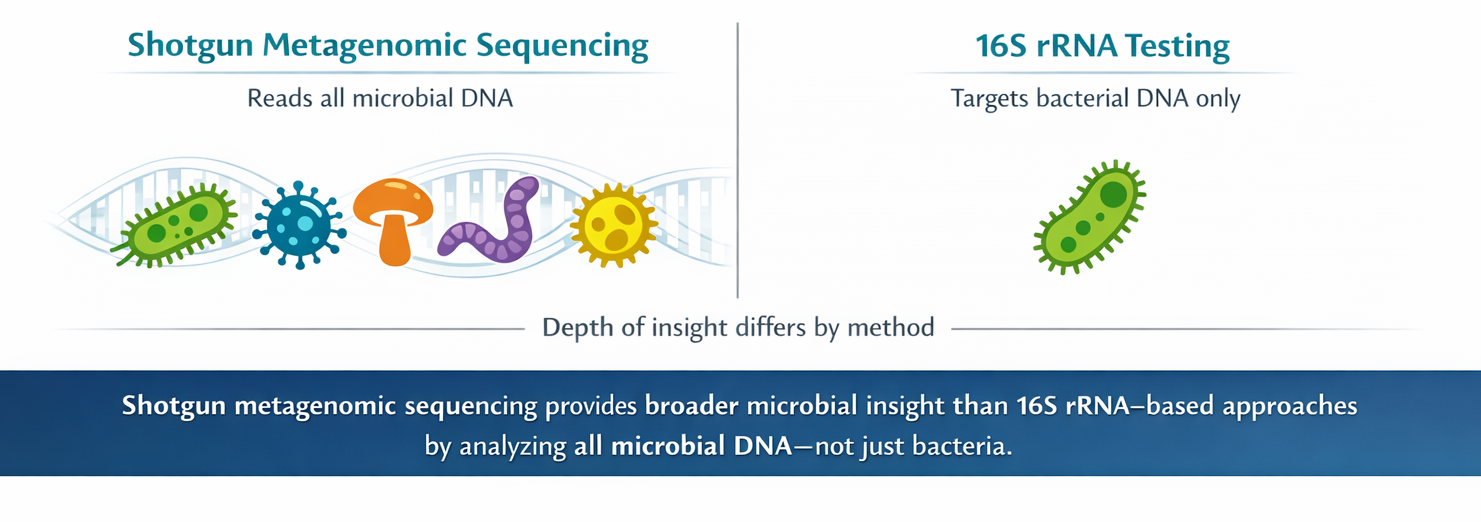
Shotgun metagenomic sequencing identifies microbes down to the species and strain level, detects fungi, viruses, and archaea, and reveals functional pathways tied to inflammation and metabolism, capabilities that 16S sequencing, used by most at-home gut tests, cannot provide.
Gut health has become one of the biggest trends in wellness. Everywhere you look, there's a new at-home microbiome test promising to tell you what's going on inside your gut. But here's something most people don't realize: not all gut tests use the same technology — and the differences are substantial. If you've ever wondered why some tests feel vague, generic, or hard to act on, the answer usually comes down to the sequencing method behind them.
Let’s break it down in a way that’s easy to understand.
What is 16S Sequencing, and Why Do Most Gut Tests Use It?
16S rRNA sequencing is a method that analyzes one small gene found in bacteria to estimate which bacterial types are present and in what quantities.
It's the most commonly used technology in consumer gut tests because it's cheap, fast, and easy to run. But those advantages come with serious limitations.
What 16S can do: It looks at one small gene found in bacteria. From that single gene, it can estimate:
- Identify which types of bacteria are present
- Estimate roughly how much of each type
- Measure basic diversity
What 16S cannot do:
- Identify microbes at the species or strain level
- Detect fungi, viruses, or archaea
- Reveal what your microbes are actually doing
- Uncover functional pathways or early biological signals
This is why most 16S-based reports feel like: "You have more of this bacteria and less of that one." Technically accurate, but not actionable.
What is Shotgun Metagenomic Sequencing?
Shotgun metagenomic sequencing reads all the DNA in a biological sample — not just one gene — allowing it to identify every type of microorganism present and what those microorganisms are doing at the functional level.
A smaller number of companies, including Dayhoff Health, use this far more advanced approach.
What shotgun sequencing can do:
- Identify microbes down to the species and strain
- Detect bacteria, fungi, viruses, and archaea
- Reveal functional pathways tied to inflammation, metabolism, and gut health
- Capture early biological signals long before symptoms appear
- Provide actionable insights, not just lists
Think of it this way:
16S sequencing tells you the ingredients in your kitchen. Shotgun metagenomics tells you what meals you can make, what's missing, and what's starting to spoil.
Why Does This Difference Matter for Your Health?
If you're trying to understand inflammation, improve digestion, support metabolism, track long-term gut health, or catch early signals before they become problems — a partial picture isn't enough.
Most at-home tests give you a genus-level snapshot of your bacteria. That's a starting point, not a complete answer. To make real decisions about your health, you need to know what species and strains are present, what other microorganisms are living in your gut alongside bacteria, and what all of those microbes are actually doing at a functional level.
That's the gap shotgun metagenomics fills. And it's why the technology behind your test matters more than the packaging around it.
Why Dayhoff Health Uses Shotgun Metagenomics
Dayhoff Health built its testing platform on shotgun metagenomic sequencing specifically because it's the only method capable of delivering a full-system view of the gut microbiome — not just a list of bacteria, but a functional map of what's happening and why.
Most at-home gut tests use 16S sequencing, which gives you a partial picture. Dayhoff Health uses shotgun metagenomics to give you the full story.
If you want insights you can actually act on, the technology behind your test is the most important variable.
Frequently Asked Questions
What is the difference between 16S and shotgun sequencing? 16S sequencing analyzes a single bacterial gene to estimate the presence of bacteria at a broad level. Shotgun sequencing reads all DNA in a sample, identifying every microorganism — including fungi, viruses, and archaea — down to the species and strain, and the functional pathways they influence.
Why do most gut tests use 16S instead of shotgun sequencing? 16S sequencing is significantly cheaper and faster to run, making it the default choice for most consumer gut test companies. Shotgun metagenomics requires more advanced processing and analysis, which is why fewer companies offer it.
Can a 16S test tell me about inflammation or metabolism? No. 16S sequencing cannot detect functional pathways, so it cannot directly link your microbiome data to outcomes such as inflammation, metabolic function, or immune activity. That level of insight requires shotgun metagenomic sequencing.
What makes Dayhoff Health's gut test different? Dayhoff Health uses shotgun metagenomic sequencing, which provides species- and strain-level identification, full ecosystem coverage (bacteria, fungi, viruses, archaea), and functional pathway analysis — delivering actionable health insights rather than a generic list of bacteria.
Is shotgun sequencing worth it over a standard gut test? If your goal is to understand your gut health deeply enough to act on it — not just satisfy curiosity — then yes. Shotgun sequencing is the only method currently capable of providing the functional data needed to make meaningful health decisions based on microbiome testing.
Dayhoff Health uses shotgun metagenomic sequencing to deliver clinically meaningful insights into gut health. Learn more at dayhoffhealth.com.